Governance · Edition III · September MMXXVI · 5 min
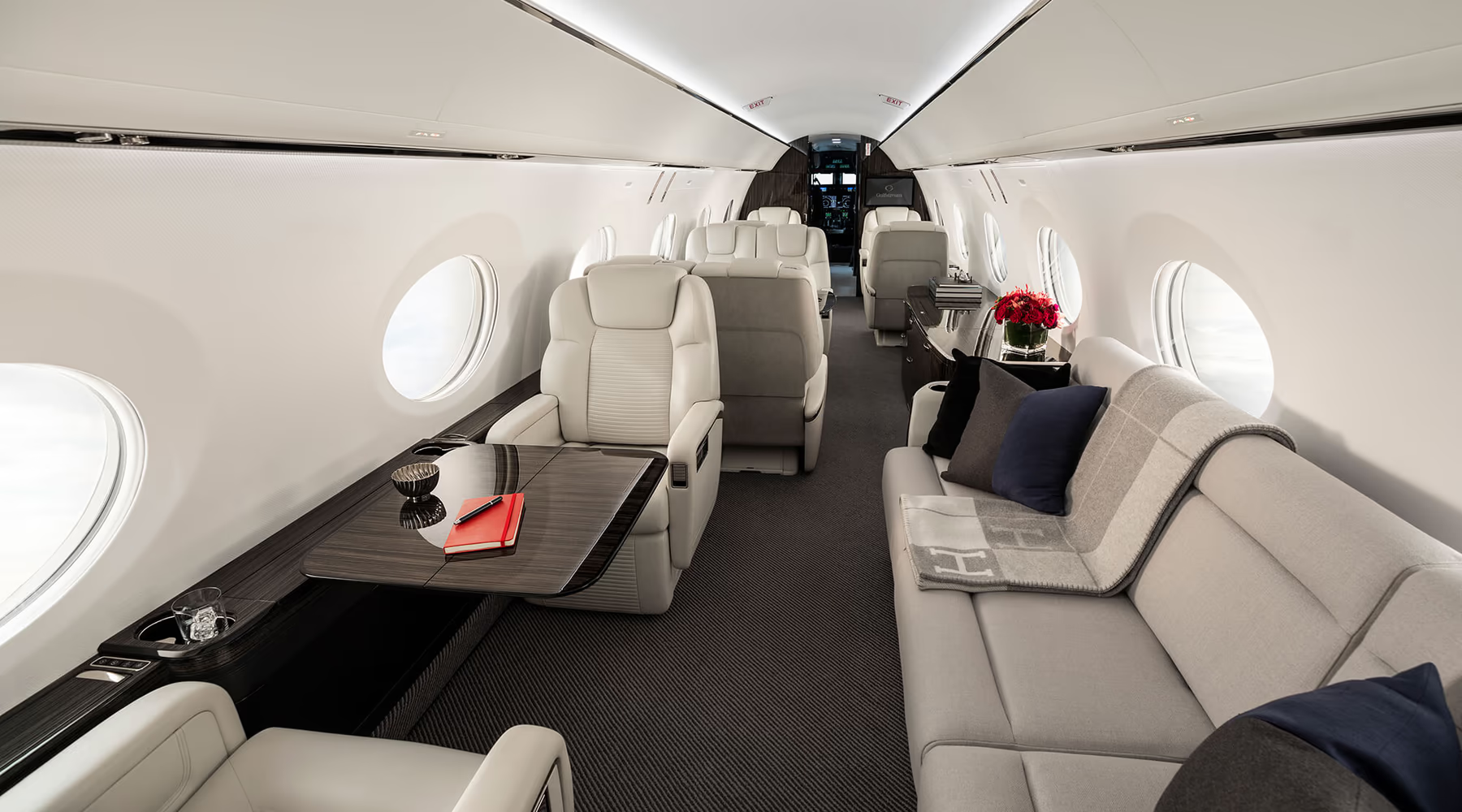
xxxviii. Cabin · the plan matters more than the delay
An aircraft on maintenance status isn't an aviation failure. The failure is having no documented response when the aircraft is unavailable. A continuity plan should define who confirms the aircraft status, who activates supplemental lift, and who approves changes to the mission.
First establish the facts
The flight department should identify the defect or scheduled task, expected downtime, maintenance location, return-to-service conditions, and uncertainty range. "Back tomorrow" isn't an operational plan unless the maintenance provider has confirmed the work scope and release requirements.
The FAA requires aircraft maintenance and return-to-service actions to be documented. FAA guidance states that after maintenance, an aircraft must be approved for return to service before operation, and maintenance records must contain appropriate entries. A replacement charter shouldn't be treated as a reason to rush the owned aircraft back into service.
Activate the fallback
The continuity plan should contain an approved vendor list and a standard mission brief. It should preserve passenger privacy while providing the operator enough information to confirm aircraft suitability. It should also define acceptable changes: aircraft class, cabin layout, nonstop capability, airport, departure window, and baggage.
The operator and aircraft must be re-vetted even when the request is urgent. The FAA warns consumers to verify charter authority and encourages checking the aircraft and operator through official records.
Close the loop
After the trip, reconcile the charter invoice and record the disruption. Track cause, response time, aircraft substitution, cost variance, and passenger impact. Repeated maintenance disruptions may justify a policy change, a spare-capacity arrangement, or a review of the fleet's mission fit. The right response isn't necessarily to buy another aircraft — it's to understand the cost and frequency of the gap.
Related reading
Governance
Supplemental lift, for the mission your aircraft can't fly.
Supplemental lift isn't an admission that the flight department failed. It's a capacity-control mechanism — and it works best when the triggers are defined before the request is urgent.
Governance
When a flight department should charter instead of fly.
Chartering isn't a referendum on the owned aircraft. It's a capacity decision — use the fleet when it's the right tool, and source lift when it isn't.
Operations
AOG and time-critical charter — how a real response works.
A compressed decision process isn't a reason to remove controls. It's measured by the quality of the decision chain, not by how fast a preliminary quote arrives.
§For correspondence on this note — or any mission it raises — write directly to the principal.